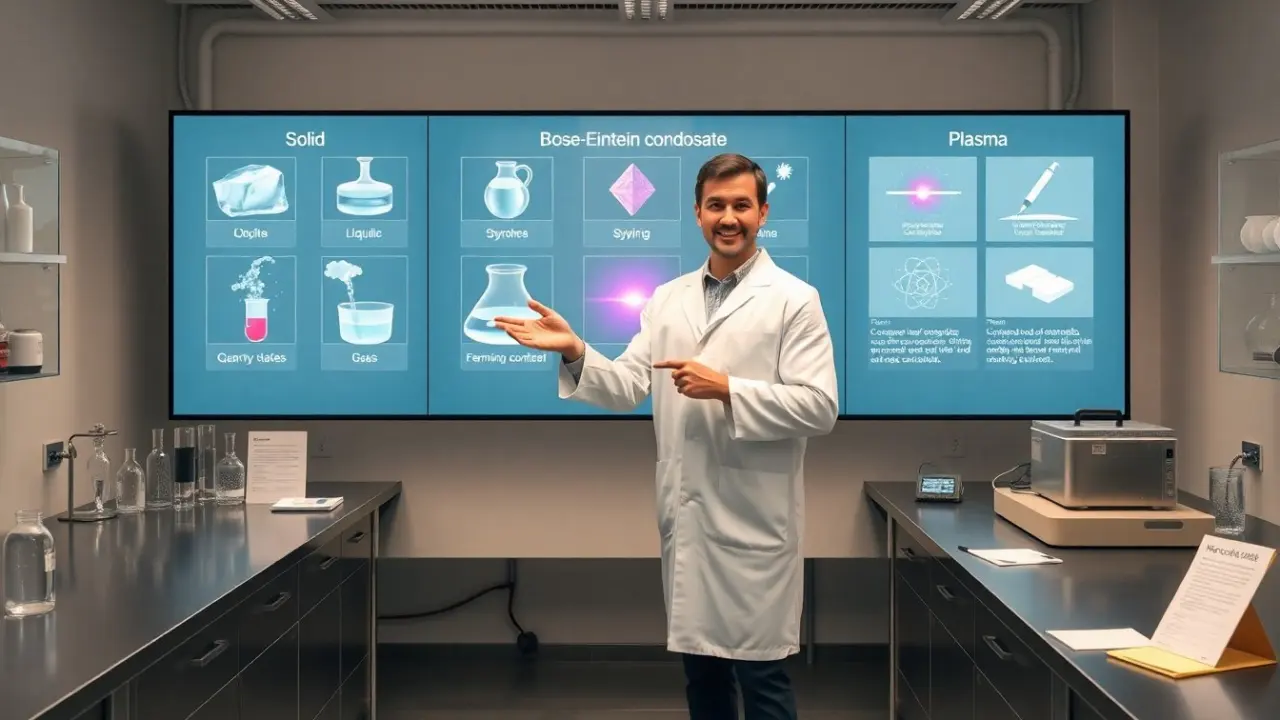
How many states of matter are there appears in many science questions. The reader asks it to know which forms matter takes. This article gives a brief number, then explains the main types. It shows modern examples that readers see in daily life and in labs. The text uses clear terms and short sentences. The reader will leave with a practical list and quick facts.
Key Takeaways
- There are at least six common states of matter regularly discussed: solid, liquid, gas, plasma, Bose–Einstein condensates, and fermionic condensates.
- The classical four states—solid, liquid, gas, and plasma—are defined by particle arrangement and energy, with plasma featuring ionized particles that conduct electricity.
- Plasma, the fourth state, dominates the visible universe and appears in natural phenomena like the Sun, lightning, and man-made devices such as neon signs.
- Beyond the classical states, additional states like superfluids, superconductors, topological states, and time crystals arise under extreme temperature or quantum conditions.
- Modern science recognizes these extra states of matter to explain novel materials and advanced technologies, expanding the traditional understanding of how many states of matter there are.
- Understanding the various states of matter helps in grasping both everyday materials and cutting-edge scientific research.
Quick Answer: The Short, Useful Number
How many states of matter are there? The simple answer is: at least six common states are regularly discussed today. Scientists list the classical four first: solid, liquid, gas, and plasma. They then add states such as Bose–Einstein condensates and fermionic condensates, plus several high-energy or low-temperature variants. This answer fits most classroom and general-science needs. When precise research matters, scientists count additional exotic states defined by quantum properties or by extreme conditions.
The Classical Four States And What Defines Them
Scientists taught four main states for decades. They explain each state by particle arrangement and energy. The next subheadings describe solid, liquid, and gas. Each part shows defining traits and everyday examples.
Solid: In a solid, particles (atoms, ions, or molecules) are closely packed and have fixed positions or vibrate around fixed points. This arrangement gives solids a definite shape and volume. Examples include ice, metals, and most minerals. The mechanical properties of solids—like hardness and elasticity—depend on how particles are bonded and arranged in a crystal or amorphous structure.
Liquid: In a liquid, particles are still close together but can move past one another, which gives liquids a definite volume but no fixed shape; they take the shape of their container. Liquids conduct heat and sometimes electricity (if ions are present), and surface tension and viscosity are key properties. Common examples are water, oils, and molten metals.
Gas: In a gas, particles are far apart relative to their size and move freely, filling any container they occupy. Gases have neither definite shape nor definite volume at ordinary conditions and are compressible. Temperature and pressure changes strongly affect gases, which is why concepts like the ideal gas law are useful approximations in many situations.
Plasma Explained: The Fourth (And Often Overlooked) State
Plasma appears when a gas gains enough energy to ionize atoms. Its particles include free electrons and ions. Plasma conducts electricity and responds to magnetic fields. The Sun and neon signs show plasma in daily examples. When students ask how many states of matter are there, teachers emphasize plasma because it dominates the visible universe. Plasmas occur in lightning, fusion experiments, and some industrial devices. Scientists create plasma by heating gas or by using strong electric fields.
Beyond natural examples, plasma is central to technologies such as fluorescent and LED lighting, plasma televisions (in older designs), industrial plasma cutters, and experimental fusion reactors. In astrophysics, most of the visible matter in stars and interstellar space is in the plasma state. Laboratory plasmas are diagnosed with probes and spectroscopy to measure temperature, density, and degree of ionization.
Beyond Four: Common Additional States Scientists Recognize
Scientists add more states once they probe extremes of temperature and quantum effects. Bose–Einstein condensates (BECs) form when atoms cool near absolute zero and occupy the same quantum state. Fermionic condensates form from paired fermions at low temperature. These condensates show quantum behavior at macroscopic scales. Other recognized states include superfluids, superconductors, and quantum spin liquids. Many of these appear in labs and advanced technologies. When people ask how many states of matter there are, modern answers include these quantum states and several high-energy phases. Researchers also describe topological states and time crystals in current literature. These additions raise the count beyond the classical four and help explain novel materials and devices.
Superfluids, for example, flow without viscosity and display phenomena like creeping up container walls; helium-4 and ultracold atomic setups produce these effects. Superconductors, which allow electrical current to flow with zero resistance, are vital in MRI machines, particle accelerators, and proposed power applications. Topological states are distinguished not by local order but by global properties of their electronic structure and can host robust edge currents useful in quantum devices.
High-energy states, such as quark–gluon plasma, arise at extreme temperatures and densities in particle collisions or in the early universe; these phases are a focus of experimental physics but are not part of everyday experience. Time crystals and other recently proposed states show how the definition of “state of matter” can evolve: scientists now classify states by symmetry, topology, and collective behavior as well as by simple packing and energy.
How many states of matter are there depends on the level of detail desired. For everyday use, saying “four” (adding plasma makes it four) or “six” (counting common quantum condensates) is often sufficient. For research and advanced materials science, the list grows as scientists identify new collective behaviors and classify them by underlying principles. Understanding this hierarchy—from solids to exotic quantum phases—helps connect classroom ideas to current scientific frontiers.