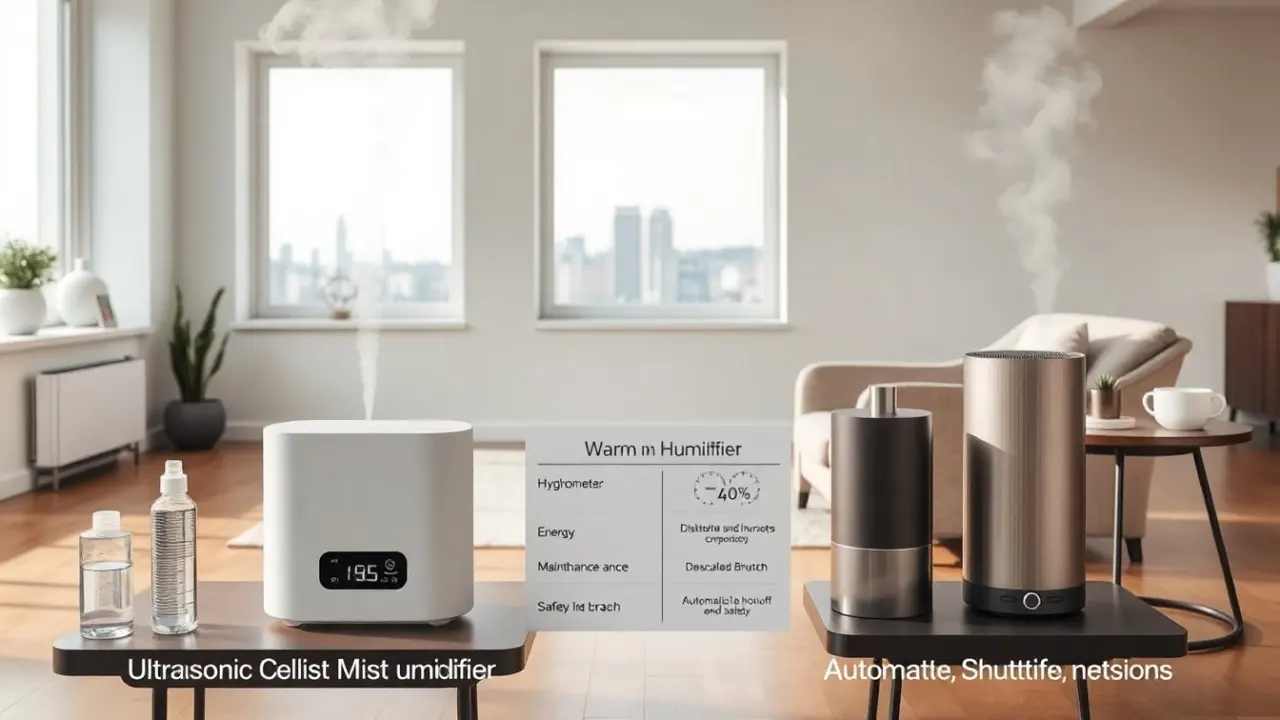
Cool mist vs warm mist humidifier is a common question for home buyers. The article explains how each device works. It lists health and safety trade-offs. It covers use cases, maintenance, noise, energy, and cost. Readers will get clear criteria to pick the best humidifier for their space in 2026.
Key Takeaways
- Cool mist humidifiers use a fan or ultrasonic vibration to disperse water droplets without heat, making them energy-efficient and safer around children and pets.
- Warm mist humidifiers boil water to release steam, which can reduce some microbes and add warmth but pose burn risks and use more electricity.
- Choosing the right humidifier depends on room size, tank capacity, and use case, with cool mist better for large rooms and child safety, and warm mist suitable for smaller bedrooms needing warmth.
- Regular maintenance is crucial: clean cool mist units frequently to prevent mold, descale warm mist devices to remove mineral buildup, and replace filters as recommended.
- Monitor indoor humidity between 40% and 50% using a hygrometer to avoid mold and allergens, and consider using distilled water to reduce mineral deposits in cool mist humidifiers.
- Prioritize safety features like automatic shutoff and stable bases, and place humidifiers on water-resistant surfaces away from electronics and wood to prevent moisture damage.
How Cool Mist and Warm Mist Humidifiers Work (Basic Mechanisms and Performance)
Cool mist vs warm mist humidifier refers to two main humidifier types. A cool mist humidifier uses a fan or ultrasonic plate. It turns water into tiny droplets. It sends droplets into the air without heat. An ultrasonic cool mist model uses high-frequency vibration. A cool mist evaporative model uses a wick and fan.
A warm mist humidifier uses heat to boil water. It releases steam into the room. The device contains a heating element and a small boiling chamber. The steam cools slightly before it reaches people.
Performance differences affect room output and coverage. A cool mist humidifier can humidify large rooms quickly. It often runs with less energy than a warm mist device. A warm mist humidifier produces visible steam. It can feel warmer near the unit. A warm mist device can reduce some microbes by heat. A cool mist unit may disperse minerals from tap water as fine white dust unless it uses distilled water or a demineralization filter.
The reader should compare output rates. Manufacturers list gallons per day or square feet coverage. The reader should match the output to the room size. The reader should also check tank capacity. Larger tanks run longer between refills. The reader should note run-time and refill frequency when choosing.
Beyond headline differences, consider how each technology behaves in practice. Ultrasonic cool mist units create a very fine aerosol that settles slowly and raises room humidity efficiently, but that same aerosol can carry dissolved minerals and any organisms present in the tank if not cleaned. Evaporative cool mist units rely on airflow across a wet wick and are self-limiting to some degree—the drier the room, the faster they evaporate water—so they can be more stable in maintaining target humidity without producing visible mist. Warm mist units deliver steam that is visually obvious and feels immediate; because the water is heated, some volatile compounds and a portion of microbes may be reduced before release, but the overall humidification rate and distribution depend on steam output and room air circulation.
Practical performance considerations: check the humidistat or compatibility with an external hygrometer, the shape and direction of the outlet (which affects coverage), and whether the unit supports continuous or intermittent modes. If you live in a hard-water area, a cool mist ultrasonic unit without a demineralization cartridge will likely leave more residue than a warm mist unit, which tends to trap minerals in the boiling chamber to be cleaned out later.
Health, Safety, and Allergy Considerations: Benefits and Risks Compared
People ask about cool mist vs warm mist humidifier for health reasons. Both types raise indoor humidity. Proper humidity reduces dry skin and throat irritation. Proper humidity can ease cough and dry nasal passages.
Warm mist humidifiers heat water and lower some bacteria count in the steam. They can reduce certain microorganisms before release. Warm steam can hurt a child or pet if spilled. The reader should place warm mist units out of reach.
Cool mist humidifiers do not use heat. They carry less burn risk around children and pets. They can spread minerals and biological particles if the unit lacks good filters. The reader should clean cool mist units often to avoid mold and bacteria growth.
Allergy and asthma guidance favors stable humidity between 40% and 50%. High humidity above 60% can encourage dust mites and mold. The reader should use a hygrometer to monitor indoor humidity. The reader should clean tanks weekly. The reader should empty and dry tanks between uses when possible.
People with severe allergies should consult a medical professional before changing home humidity. The reader should also consider using distilled water to reduce mineral dispersal in cool mist models. The reader should use filters where the manufacturer recommends them.
Added practical safety and allergy tips: when using any humidifier, avoid placing it directly on wooden furniture or unsealed floors—condensation can lead to warping or mold behind baseboards. If someone in the household has asthma or multiple chemical sensitivities, be cautious with scented additives; many manufacturers and clinicians advise against adding essential oils or medicinal drops directly to the tank unless the unit is explicitly designed for them. For households with infants or toddlers, prefer cool mist units with locked lids and stable, low centers of gravity; for elderly or immunocompromised occupants, prioritize units with easily replaceable filters and clear cleaning instructions to minimize microbial exposure.
Troubleshooting health-related issues: if you notice increased nasal congestion, persistent coughing, or visible mold growth on walls, check your indoor RH with a hygrometer and lower humidity if it exceeds recommended levels. Discontinue use and deep-clean the humidifier if you detect musty odors coming from the unit.
Choosing The Right Humidifier: Use Cases, Maintenance, Noise, Energy, And Cost
The reader should match the humidifier to common use cases. For a child’s room, a cool mist humidifier often fits best because it avoids burn risk. For small bedrooms, a warm mist humidifier may add a pleasant warming effect. For large living areas, a high-output cool mist model with a large tank can run longer.
Maintenance affects long-term satisfaction. Cool mist units need regular cleaning to prevent microbial growth. The reader should follow the manufacturer’s cleaning schedule. Warm mist units need descaling to remove mineral buildup on the heating element. The reader should replace filters on schedule and use distilled water when recommended.
Noise matters in bedrooms and offices. Ultrasonic cool mist humidifiers run very quietly. Evaporative cool mist units use a fan and can make a low hum. Warm mist humidifiers often run quietly because they have no fan, but they may cycle more audibly when the heating element switches on.
Energy use varies. Warm mist humidifiers use more electricity because they boil water. The reader should expect higher operating costs with warm mist units in continuous use. Cool mist humidifiers often use less power. The reader should compare wattage and estimated daily cost in the product specs.
Upfront cost and parts matter. Cool mist models vary from low-cost personal units to higher-cost whole-room designs. Warm mist models sit in the mid-price range for single rooms. The reader should add filter replacement and descaling supplies to the cost estimate.
The reader should check safety features. Look for automatic shutoff on empty tanks and stable base design. The reader should read user reviews for reliability and customer service experiences.
Finally, the reader should test placement. Place the humidifier on a level, water-resistant surface. Keep the device a few feet from walls and electronics. The reader should aim the mist away from wood floors and fabrics to avoid moisture damage.
Buying checklist and practical selection steps: 1) Measure the room and pick a unit rated for that square footage; 2) Decide between portability (small tanks, personal units) and low-maintenance whole-room models (larger tanks, console units); 3) Choose features you will actually use—built-in humidistat, timer, adjustable mist output, and ease of tank removal; 4) Factor in ongoing costs like filter replacements and descaling supplies; 5) Verify warranty length and availability of replacement parts; 6) Read recent user reviews focused on reliability and cleaning difficulty.
Routine maintenance plan you can follow: empty and dry the tank daily if using intermittently; do a basic clean once per week with a manufacturer-recommended solution or diluted vinegar; deep clean and descale the heating chamber of warm mist units every 1–4 weeks depending on water hardness; replace filters according to the manufacturer schedule or sooner if you notice odors or reduced output; keep a hygrometer nearby and adjust use to maintain 40%–50% relative humidity.
Troubleshooting common issues: if the mist output declines, check for mineral buildup or clogged nozzles and descale or replace cartridges; if you see white dust from an ultrasonic unit, try distilled water or use a demineralization cartridge; if the unit leaks, ensure the tank is seated correctly and seals are intact; if the unit cycles on and off frequently, confirm whether the built-in humidistat is set appropriately or switch to manual mode to diagnose.