This article lists facts about black holes and explains key ideas clearly. It states what scientists know and how they know it. It avoids jargon and gives concrete examples. It helps readers grasp the main discoveries and why those discoveries matter.
Key Takeaways
- Black holes concentrate mass into a small area with gravity so strong that light cannot escape beyond the event horizon.
- There are different types of black holes: stellar, supermassive, intermediate, and the hypothetical primordial black holes.
- Scientists observe black holes through their gravitational effects, X-ray emissions, and recent direct images like those from the Event Horizon Telescope.
- Gravitational wave detectors have revolutionized black hole studies by measuring waves from black hole mergers, providing key data on their properties.
- Black holes do not act like vacuum cleaners; objects only fall in if they pass close enough, and they play a crucial role in powering bright cosmic phenomena like quasars.
- Studying black holes advances fundamental physics, technology, and enriches culture by inspiring education and popular media.
What A Black Hole Is — Key Concepts Explained Simply
A black hole is an object that concentrates mass into a small region. Gravity there becomes so strong that light cannot escape. Astronomers name the boundary where light cannot escape the event horizon. Matter that crosses the event horizon moves inward and increases the black hole mass.
Black holes come in different sizes. Stellar black holes form when massive stars end their lives. Supermassive black holes sit at galaxy centers and hold millions to billions of solar masses. Intermediate black holes have masses between the two.
Scientists describe black holes with a few parameters. Mass sets the size and gravity. Spin sets how the black hole drags space. Electric charge matters very little for real black holes. These simple parameters let physicists predict orbits, energy release, and gravitational waves.
Black holes follow general relativity. General relativity predicts spacetime curvature near mass. Relativity yields the black hole solutions used in observations. Quantum theory raises questions near the event horizon. Those questions drive active research and experiments.
How Black Holes Form And The Different Types
Stellar black holes form when stars end by core collapse. The star burns fuel, the core collapses, and the remnant compresses into a compact object. If the remnant mass passes a threshold, it becomes a black hole. Typical stellar black holes range from about five to fifty solar masses.
Supermassive black holes form by growth over time. They grow by accreting gas and by mergers with other black holes. Early in the universe, dense gas and rapid growth created massive seeds that reached millions of solar masses within a few hundred million years.
Intermediate black holes span a mass gap between stellar and supermassive. Observations now provide candidate objects in the hundreds to thousands of solar masses. These candidates appear in dense star clusters and in some galactic centers.
Other types include primordial black holes, which would form from early-universe density fluctuations. No definitive detection exists for primordial black holes. The classification helps observers decide which signals to look for and what instruments to use.
How We Observe Black Holes: Evidence, Images, And Gravitational Waves
Observers infer black holes by their effects on nearby matter and light. Gas orbiting a black hole heats and emits X-rays. Stars orbiting an invisible mass reveal a compact massive object by their orbital motion. These methods produced early, strong evidence for black holes.
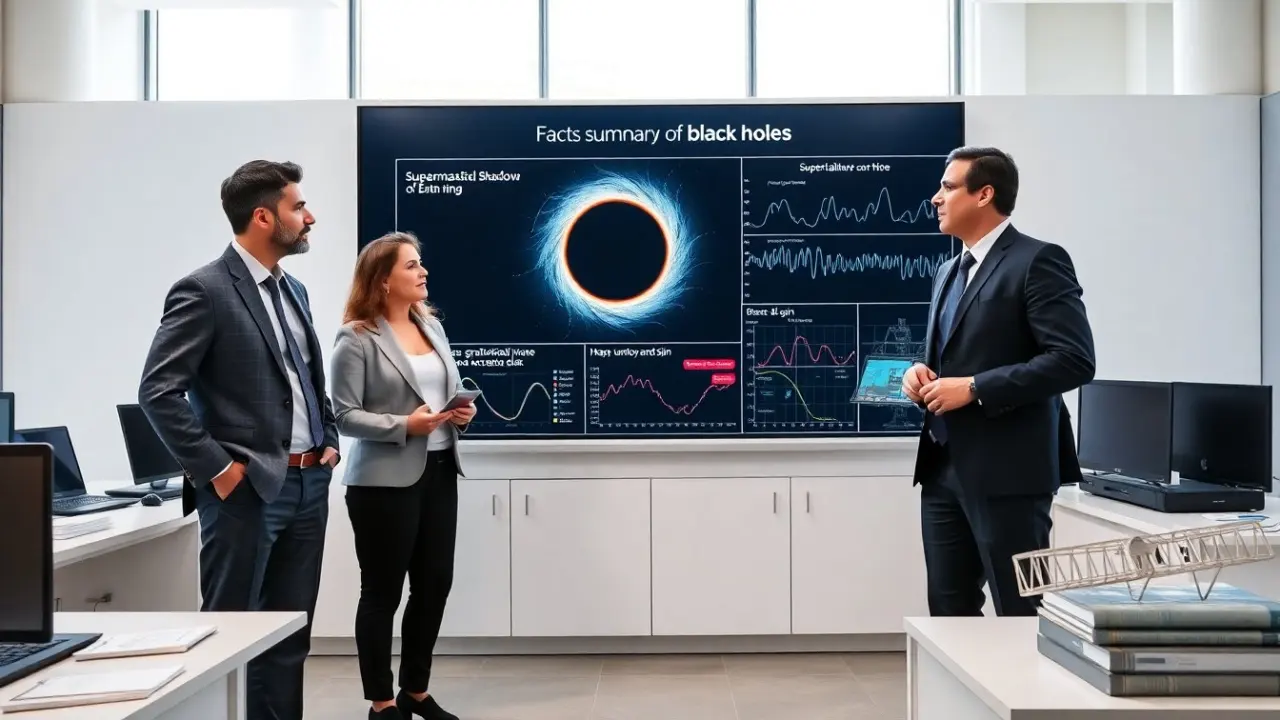
In 2019 and 2022, the Event Horizon Telescope produced images of the shadow around supermassive black holes. Those images show a bright ring and a darker central region consistent with theory. The images confirm predictions from general relativity about light bending near the event horizon.
Gravitational wave detectors now measure ripples from black hole mergers. LIGO and Virgo first detected these waves in 2015. Each detection provides mass, spin, and distance for the merging black holes. The data also reveal merger rates and inform stellar evolution models.
X-ray telescopes, radio arrays, and optical observatories all play roles. Multi-messenger astronomy combines light and gravitational waves to give a fuller picture. This combined approach improves the accuracy of mass and spin measurements and reveals transient phenomena like tidal disruption events.
Surprising Facts, Common Misconceptions, And Why Black Holes Matter
Fact: Black holes do not act like vacuum cleaners. Objects only fall in if they come close enough. Earth would not fall into the Milky Way’s central black hole under normal conditions.
Fact: Time runs slower near a black hole for a distant observer. This time dilation follows relativity. It produces measurable effects on clock signals and on the appearance of infalling matter.
Misconception: Black holes suck everything instantly. A person crossing the event horizon would not feel strong forces at the horizon for a very large black hole. Tidal forces matter more for smaller black holes.
Fact: Black holes power some of the brightest objects in the sky. Active galactic nuclei and quasars shine when accretion disks convert gravitational energy into light. These sources shape galaxy evolution through feedback.
Fact: Black holes test fundamental physics. Observations constrain gravity theories and particle properties. They also inform models of high-energy plasmas and magnetic fields.
Fact: Studying black holes improves technology. The data analysis methods for gravitational waves and the imaging algorithms for the Event Horizon Telescope led to advances in signal processing and computing.
Fact: Black holes influenced human culture and education. They appear in textbooks, public talks, and popular media. That interest helps fund science and attracts students to physics and astronomy.
Overall, facts about black holes show that these objects offer precise tests of physics and practical benefits for technology. Scientists continue to measure, model, and test to refine the current picture.