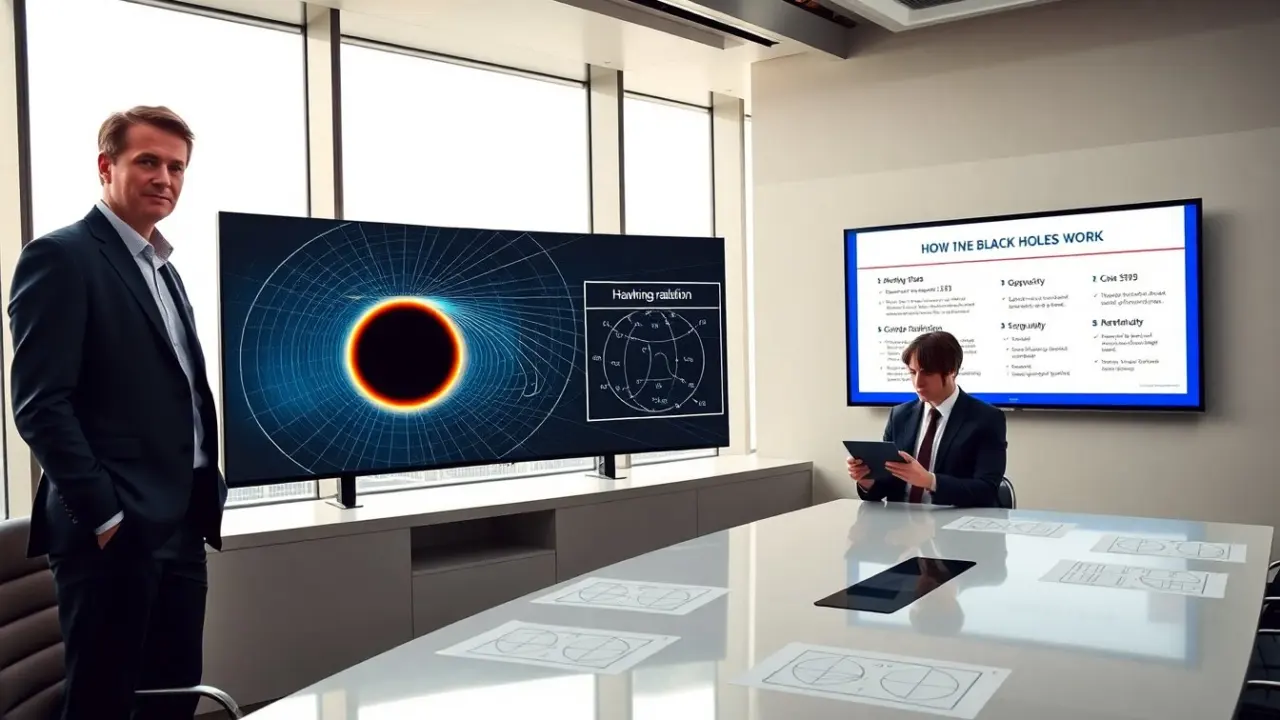
how do black holes work is the question this guide answers in plain terms. It explains mass, gravity, and the singularity. It shows event horizons, the Schwarzschild radius, and matter infall. It outlines how black holes bend space, time, and light. It covers Hawking radiation and open questions in quantum gravity. It keeps language simple and direct for quick understanding.
Key Takeaways
- A black hole forms when massive matter collapses under its own gravity, compressing mass into a singularity with extremely high density and gravity.
- The event horizon marks a point of no return where light and matter cannot escape, defined by the Schwarzschild radius for non-rotating black holes.
- Black holes bend space, time, and light, causing effects like gravitational lensing, time dilation, and space-time dragging around rotating black holes.
- Matter falling into black holes loses energy and angular momentum in an accretion disk before crossing the event horizon, often producing observable X-rays and jets.
- Hawking radiation causes black holes to slowly evaporate by emitting particles due to quantum effects near the horizon, but many questions about quantum gravity and information remain unanswered.
What Is A Black Hole? Mass, Gravity, And The Singularity
A black hole forms when massive matter collapses under its own gravity. Stars burn fuel and they hold themselves up by pressure. When fuel runs out, gravity wins and the core collapses. The collapse compresses mass into a very small region. The region creates a point that classical physics calls the singularity. The singularity has very high density and very high gravity. Physicists say general relativity predicts infinite curvature at the singularity. Observers far away measure only mass, charge, and spin. These three properties define a black hole for external observers. Astronomers find black holes by their effects on nearby gas and stars. They watch for bright disks of infalling gas and for high-speed stars near the center. They infer mass from orbital motions and from emitted light. The phrase how do black holes work appears in many public questions. The simple answer: mass produces gravity and the collapsed mass creates a region that traps matter and light.
Event Horizon, Schwarzschild Radius, And How Matter Falls In
The event horizon marks the boundary where escape becomes impossible. Light and matter cross the horizon and they cannot return. The Schwarzschild radius gives the horizon size for a non-rotating black hole. The radius equals two times the gravitational constant times mass divided by the speed of light squared. Observers outside see matter slow and redden as it approaches the horizon. Local observers near the matter see normal motion until tidal forces grow large. Tidal forces stretch and compress objects near smaller black holes. In larger black holes tidal effects at the horizon can be small. Gas forms an accretion disk before it falls in. Friction in the disk heats gas and the disk emits X-rays and visible light. Magnetic fields launch jets from the disk and they carry energy away. Telescopes capture light from disks and jets to map where matter falls. Many readers ask how do black holes work when they read about disks and jets. The answer: matter loses energy and angular momentum in the disk and then it crosses the horizon.
How Black Holes Bend Space, Time, And Light — Relativity Basics
Mass tells space how to curve and curved space tells matter how to move. This statement captures Einstein’s field idea in simple terms. A black hole produces strong curvature near its center. Light follows curved paths and so light bends near a black hole. Observers see lensing effects and multiple images of background sources. Time runs slower near a massive object compared with far away observers. Clock rates differ and they affect measurements near the horizon. Particles follow paths called geodesics that local observers call free fall. Spin changes the picture. A rotating black hole drags nearby space and time and it creates an ergosphere. In the ergosphere, objects can gain energy and escape with more energy than they entered. This idea underlies some mechanisms for jet power. Simulations show how curved space guides gas motions and light paths. Many educators ask how do black holes work when they teach relativity. The clear reply: gravity is curvature, and black holes show curvature at its strongest.
Hawking Radiation, Evaporation, And Open Questions In Quantum Gravity
Hawking radiation arises from quantum effects near the horizon. Virtual particle pairs form in vacuum and one particle can fall inside while the other escapes. Observers far away then see radiation and they measure a temperature that depends on mass. Smaller black holes produce higher temperatures and they evaporate faster. Evaporation reduces mass and it accelerates near the end if nothing adds mass. The full quantum description remains incomplete. Physicists seek a theory that combines quantum mechanics and gravity to describe the singularity and the final stages of evaporation. They debate what happens to information that falls into a black hole. Some proposals say information escapes in subtle correlations in Hawking radiation. Other proposals say information stores in a near-horizon layer or in quantum gravity microstates. Many researchers ask how do black holes work to frame these problems. Experiments with analog systems and precision astrophysical observations aim to test parts of the theory. Progress will come from new data, thought, and improved theory.