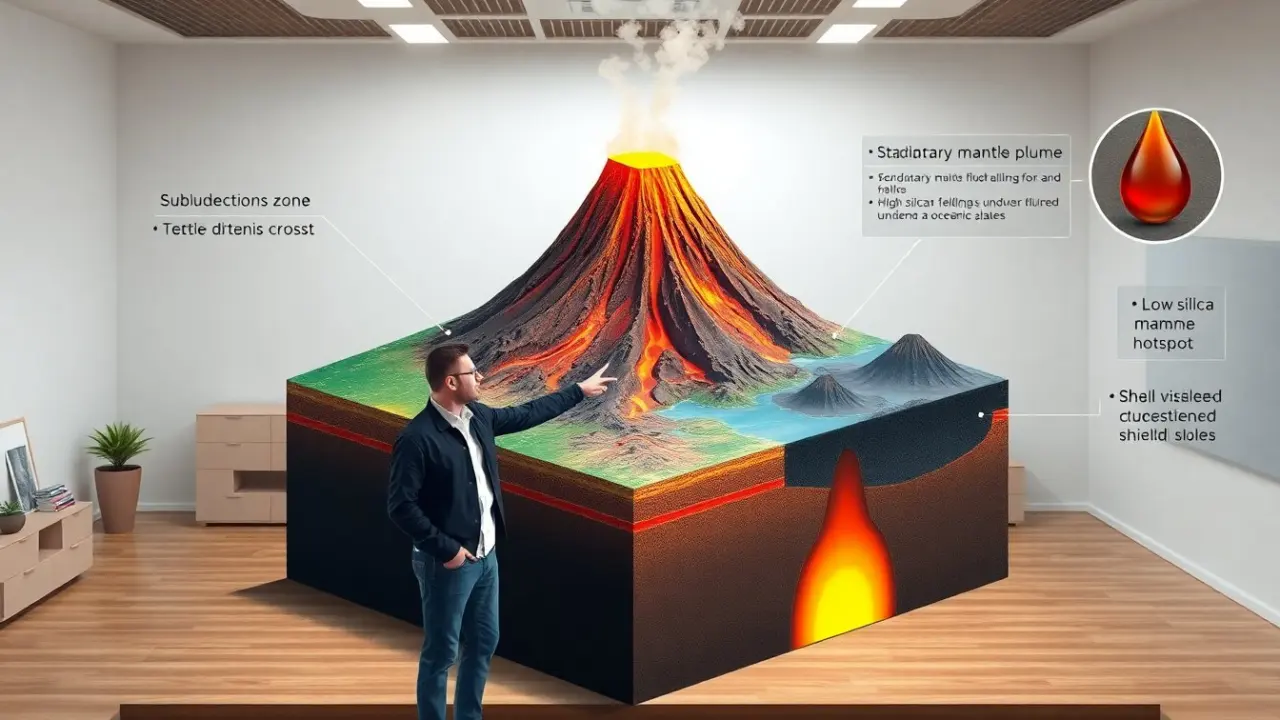
How do volcanoes form and why do they erupt? This guide explains how magma rises, how plates move, and how different volcano types grow. It uses clear facts and simple examples and adds more detail about processes, timescales, and the range of volcanic landforms. Readers will learn where magma starts, the roles of melting mechanisms, how plate edges make volcanoes, how hotspots work, and how magma chemistry and gas control eruption behavior and the shapes volcanoes make.
Key Takeaways
- Volcanoes form when magma generated by melting rock beneath the Earth’s crust rises through cracks to the surface.
- Most volcanoes occur at tectonic plate boundaries where stress and movement create pathways for magma to erupt.
- Hotspots create volcanoes away from plate edges by supplying heat and melt under a moving plate, forming volcanic island chains like Hawaii.
- Magma composition influences eruption style and volcano shape, with low-silica magma creating gentle shields and high-silica magma producing steep stratovolcanoes.
- Gas content and temperature affect the violence of eruptions, making some volcanoes more explosive than others.
- Intrusive magma can cool underground forming solid rock features that appear as volcanic plugs after erosion.
- Volcano formation is a dynamic process that can take place over seconds (an explosive eruption), years to centuries (building a cone), or millions of years (forming large igneous provinces or island chains).
What Causes Magma To Form Beneath The Crust
Magma forms when solid rock in the mantle or lower crust partially melts. There are three common ways melting begins: rising temperature, decreasing pressure, and the addition of volatiles. In mantle upwelling, rock moves upward where lower pressure allows it to cross its melting curve. At subduction zones, seawater and other fluids released from the sinking plate lower the melting point of the overlying mantle wedge and trigger melt. Heating can also occur locally where a mantle plume brings hotter material upward. The resulting melt collects in pockets and larger reservoirs called magma chambers. Over time these chambers can evolve—crystals settle, gases separate, and composition changes by mixing with other melts or assimilating surrounding rock. Because magma is typically less dense than the surrounding solid rock, buoyancy drives it upward; it exploits fractures, faults, and zones of weakness to ascend. When these pathways reach the surface, lava and ash erupt. Understanding these physical controls clarifies the mechanics behind how do volcanoes form and why some regions produce frequent eruptions while others remain quiet.
Plate Tectonics: Where Most Volcanoes Start
Most volcanoes begin where tectonic plates interact because plate boundaries concentrate heat, stress, and material exchange. At divergent boundaries, such as mid-ocean ridges, upwelling mantle partially melts as pressure drops and creates basaltic magma that forms new oceanic crust. At convergent, or subduction, boundaries, one plate dives beneath another, releasing water and other volatiles that induce melting in the overlying mantle; this process commonly produces andesitic to rhyolitic magmas and builds volcanic arcs like the Andes or the Cascades. Transform boundaries are less likely to produce volcanoes directly, but their faults can localize magma ascent in some settings. Each plate setting results in characteristic magma compositions and eruption styles: basaltic magmas at spreading centers are typically low-viscosity and produce effusive flows, whereas subduction-related magmas can be more silica-rich and gas-charged, so they tend to be more explosive. Plate motion also determines where volcanoes form over geological time—collision, rifting, and subduction patterns control the distribution of volcanic activity around the globe. These tectonic processes are central to explaining how do volcanoes form in different environments and why volcanic hazards vary regionally.
Hotspots: Volcanoes Away From Plate Boundaries
Hotspots form where a concentrated source of heat in the mantle—often called a plume—melts rock beneath a moving tectonic plate. Because the plume remains relatively stationary while the plate drifts over it, a sequence of volcanoes can form that records plate motion: the active volcano lies over the hotspot while older, extinct volcanoes trail away from it. The Hawaiian-Emperor chain is a classic example, producing large shield volcanoes with fluid basaltic lava. Hotspot magmas are usually low in silica and gas relative to many subduction-zone magmas, which favors long, flowing eruptions and broad volcano profiles. However, hotspot systems can vary: some produce explosive activity if the magma interacts with groundwater or the evolving composition becomes more silicic. Hotspots help explain how do volcanoes form even in the middle of plates and are a useful tool for studying mantle dynamics and plate kinematics over millions of years.
Magma Composition, Eruption Style, And Volcano Shape
Magma composition—chiefly its silica content—strongly influences eruption style and volcano shape. Basaltic magma is low in silica and relatively hot and fluid; it flows easily, building wide, gently sloping shield volcanoes. Andesitic magmas have intermediate silica and often build stratovolcanoes, with alternations of lava flows and explosive deposits that produce steep-sided cones. Rhyolitic magmas are high in silica, viscous, and tend to trap gases, which increases the potential for powerful explosive eruptions and the creation of calderas. Gas content (water vapor, CO2, sulfur gases) and temperature also control explosivity: higher gas pressures and cooler, more viscous magmas favor fragmentation and ash production. Crystallization and magma mixing change viscosity and gas behavior over time, so a single volcano can produce a range of eruption styles throughout its life. Some magma never reaches the surface, cooling slowly to form intrusive bodies—dikes, sills, and plutons—that later appear as resistant rock features once the surrounding material erodes. Together, composition, gas, temperature, and plumbing architecture determine how do volcanoes form into the many shapes and sizes we observe, from tiny cinder cones to massive stratovolcanoes and sprawling shield volcanoes.