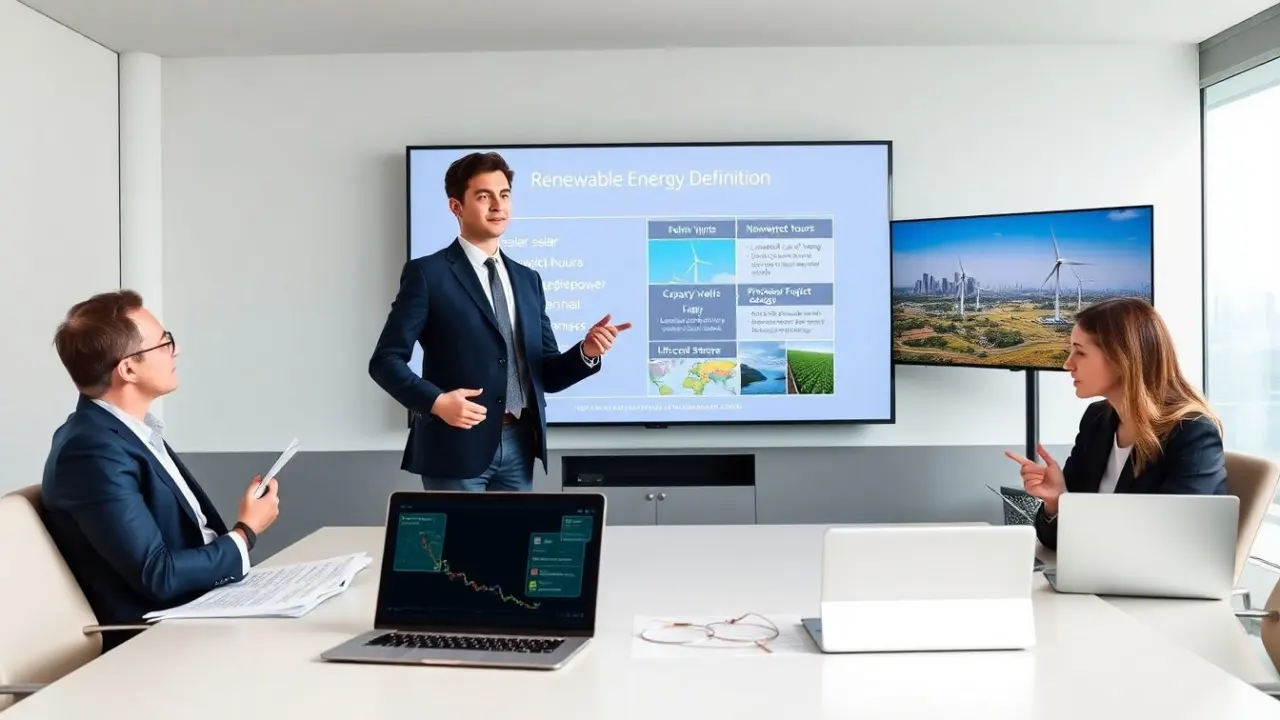
Renewable energy definition appears early in discussions about power and climate. The phrase describes energy that comes from sources that regenerate naturally and on human timescales. It excludes fuels that deplete with use. This definition guides policy, investment, and technology choices. Readers will get a clear renewable energy definition, comparisons with other terms, a concise list of main types, and practical benefits and limits. Below we expand on how the concept is applied in planning, measurement, and public communication so the term is useful rather than vague.
Key Takeaways
- Renewable energy comes from sources that naturally regenerate on human timescales, distinguishing it from finite fuels like coal and oil.
- The main types of renewable energy include solar, wind, hydropower, geothermal, and biomass, each contributing to clean power and heat generation.
- Renewable energy offers benefits such as lower emissions, reduced fuel imports, and local job creation while facing challenges like resource variability and land use constraints.
- Clear definitions and metrics guide policymakers and investors in setting targets and comparing renewable energy projects effectively.
- Combining renewables with storage and flexible generation overcomes limitations, ensuring reliable power supply and dispelling misconceptions about baseload capabilities.
Defining Renewable Energy: Core Principles And How It’s Measured
The renewable energy definition states that energy comes from sources that renew naturally. Practically, this means the resource replenishes on timescales relevant to human use — sunlight, wind patterns, river flow, geothermal heat, and plant growth. In planning and regulation, that principle is paired with operational and environmental tests: can the source provide energy at scale, how predictable is it, and what are the lifecycle impacts of extracting, converting, and using it?
Analysts measure renewable energy by several interlocking indicators. Physical output metrics include energy produced (kilowatt-hours or megawatt-hours), installed capacity (megawatts), and capacity factor, which describes how much of the installed capacity is actually used over time. Environmental metrics cover lifecycle greenhouse gas emissions, land and water use, and material inputs for construction and operation. Economic measures include levelized cost of energy (LCOE), capital expenditure, and operating cost. Policy targets commonly use the share of electricity or final energy consumption supplied by renewables, installed capacity goals, and year-over-year generation growth. Combining these metrics gives a more complete view than any single number: for example, a technology with low per-unit emissions but very high resource use may score differently across objectives.
How Renewable Energy Differs From Nonrenewable, Low-Carbon, And Alternative Terms
The renewable energy definition separates it from nonrenewable fuels like coal, oil, and natural gas. Nonrenewable resources are drawn from finite geological stores that do not replenish on human timescales, so their extraction reduces future availability. This difference matters for long-term energy planning, security of supply, and carbon accounting.
“Low-carbon” refers to the greenhouse gas emissions associated with a technology or fuel, rather than whether the source renews. Some low-carbon options, such as certain forms of nuclear power, produce minimal operational CO2 but rely on finite inputs or complex waste streams. “Alternative” is a broader, sometimes marketing-driven label that signals an option outside the dominant energy system; it may include renewable or nonrenewable technologies. Clear use of the renewable energy definition helps avoid mixing categories in policy design, subsidy programs, and reporting frameworks so that incentives match stated goals — e.g., emissions reduction versus fuel independence versus renewable deployment.
Main Types Of Renewable Energy: Overview
The renewable energy definition covers several common sources. Each source renews naturally and can produce electricity, heat, or transport fuels through different conversion processes. The main types include:
- Solar: Photovoltaic panels convert sunlight directly into electricity, while solar thermal systems concentrate heat for power generation or industrial heat. Solar is modular and deployable at small and large scales.
- Wind: Turbines extract kinetic energy from moving air to produce electricity. Wind resources vary by site and height, with onshore and offshore differences in cost and output profile.
- Hydropower: Uses flowing or falling water to drive turbines. Run-of-river, reservoir-based, and small-scale systems differ in storage capability and environmental impacts.
- Geothermal: Taps heat from the Earth for direct heating or electricity generation where temperatures and permeability permit. It provides steady baseload-like output in suitable regions.
- Biomass: Organic material can be combusted, anaerobically digested, or converted into biofuels. Sustainability depends on feedstock choice, land use, and supply chain practices.
Emerging or niche renewables, such as tidal and wave energy, advanced biofuels, and enhanced geothermal, expand options but often face higher costs or technical barriers. Each type has distinct resource characteristics, siting needs, and integration challenges; understanding those nuances is essential when applying the renewable energy definition in policy, procurement, or grid planning.
Benefits, Limitations, And Common Misconceptions About Renewable Energy
The renewable energy definition implies a set of practical benefits. Renewables typically produce much lower lifecycle greenhouse gas emissions than fossil fuels when measured across extraction, construction, operation, and decommissioning. They reduce reliance on imported fuels, improve local energy security, and create jobs in manufacturing, installation, operation, and maintenance. Distributed renewables can increase resilience by diversifying the energy mix and shortening supply chains.
However, limitations are real and context-dependent. Variability and intermittency of solar and wind mean output fluctuates daily and seasonally, which complicates grid management. Some renewable projects require significant land area or have local environmental impacts, such as habitat disruption from large hydropower reservoirs or biomass harvest. Resource siting, permitting timelines, and supply chain constraints for critical materials can slow deployment. Lifecycle impacts — including embodied emissions in manufacturing and end-of-life recycling — must be managed to realize the full environmental benefits implied by the renewable energy definition.
Common misconceptions arise when the term is used without nuance. One is that renewables cannot supply reliable power: in practice, combining diverse renewable sources with energy storage, demand response, improved grid interconnection, and flexible dispatchable generation enables reliable systems at high renewable shares. Another is that all biomass is carbon-neutral; sustainability depends on feedstock origin, regeneration rates, and land-use change. A third misconception is that low cost always equals low impact; rapid deployment without planning can create social and ecological trade-offs. Sound policy, robust metrics, and transparent lifecycle accounting ensure the renewable energy definition translates into resilient, low-impact energy systems rather than slogans.