This article lists solar system facts that matter in 2026. It gives clear numbers, simple explanations, and recent updates. It helps readers learn planets, moons, small bodies, and distances. It uses plain language and exact figures where possible. It fits readers who want fast, reliable solar system facts for study or curiosity.
Key Takeaways
- The solar system consists of one star, eight planets, five recognized dwarf planets, thousands of moons, and millions of asteroids, spanning about 100,000 astronomical units (AU) to the Oort cloud.
- It formed 4.6 billion years ago from a collapsing gas and dust cloud, creating a structured system with inner rocky planets and outer gas and ice giants.
- Inner planets like Earth and Mars have solid surfaces and higher densities, while outer planets such as Jupiter and Neptune are large, gaseous, and have extensive ring and moon systems.
- Jupiter’s strong gravity influences asteroid orbits and helps protect inner planets from comet impacts, playing a key role in solar system dynamics.
- Minor bodies include the asteroid belt, Kuiper Belt with dwarf planets like Pluto, and the distant Oort cloud, which supplies many comets; moons like Europa and Titan show signs of subsurface oceans or atmospheres.
- Missions like Voyager, Cassini, Juno, and New Horizons have significantly advanced our knowledge of the solar system facts in recent years.
Quick Snapshot: Key Numbers And Must-Know Facts
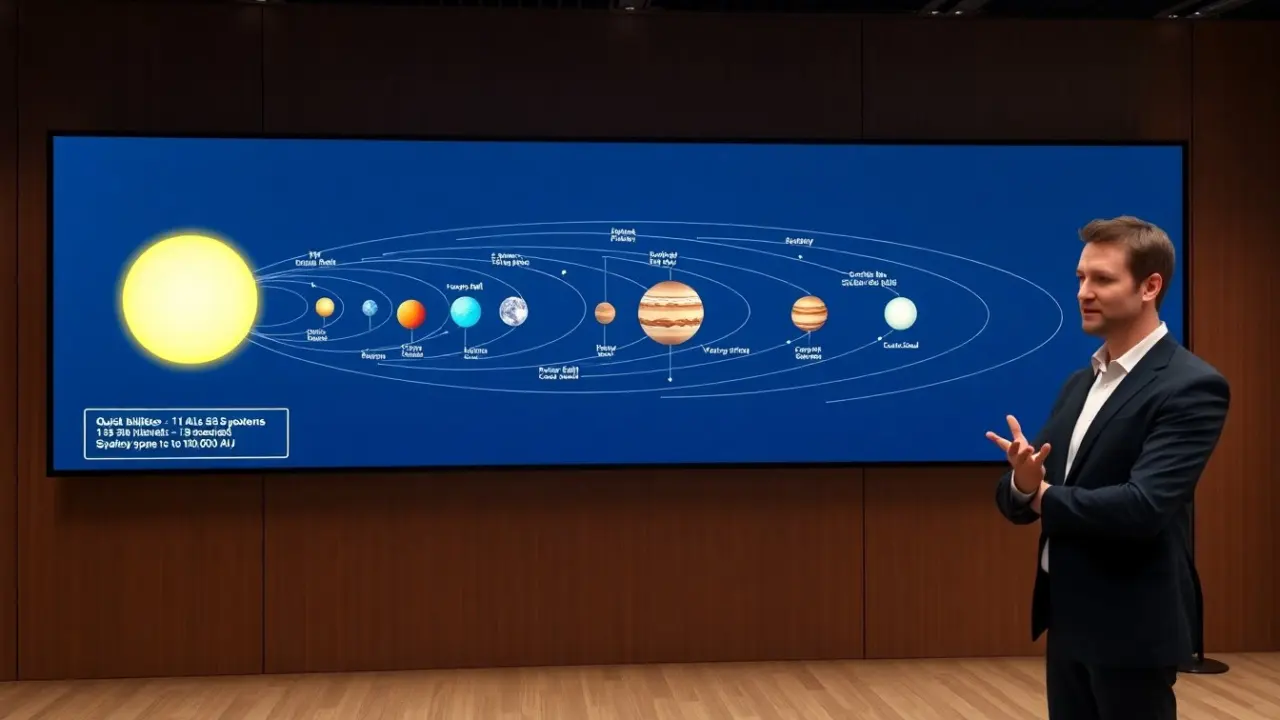
The solar system facts begin with counts and scales. The system has one star, eight planets, five recognized dwarf planets, and thousands of known moons. It holds millions of asteroids and a vast cloud of icy bodies beyond Neptune. The average distance from Earth to the Sun equals 1 astronomical unit (AU). One AU equals about 93 million miles (150 million kilometers). Light travels from the Sun to Earth in about eight minutes. The solar system spans roughly 100,000 AU when measured to the far edge of the Oort cloud. Jupiter holds most of the system mass after the Sun. Saturn shows the most visible ring system. The Kuiper Belt lies beyond Neptune and contains Pluto and other dwarf planets. Voyager probes left the heliosphere and continue to send data, making them key human-made milestones in recent solar system facts.
Beyond simple counts, the solar system’s structure is described by ranges and relationships: orbital periods that vary from months for inner planets to centuries for some distant dwarf planets, densities that reveal composition differences, and gradients in temperature and material that explain why rocky planets formed close to the Sun while volatiles condensed farther out. Observations from space telescopes and probes provide the precise measurements that underpin many of these facts, while ground-based surveys continue to discover smaller moons and distant trans-Neptunian objects.
How The Solar System Formed And How It’s Structured Today
The solar system facts start with its origin. A cloud of gas and dust collapsed under gravity about 4.6 billion years ago. The cloud spun and flattened into a disk. The Sun formed at the center. Particles in the disk stuck together and formed planetesimals. Planetesimals grew into planets and dwarf planets. The inner region became hot and produced rocky worlds. The outer region stayed cooler and produced gas and ice giants. The system arranged into zones: inner rocky planets, asteroid belt, outer gas giants, Kuiper Belt, and Oort cloud. The system retains leftover planetesimals as comets and asteroids. Migration of large planets reshaped orbits early on. Collisions created many moons and surface features. The Sun now fuels the system with light and wind. The solar wind forms a bubble called the heliosphere that affects charged particles across the system.
Modern solar system facts also emphasize processes that continue to shape what we see today. Planetary migration, resonances between orbits, and repeated impacts have sculpted planetary surfaces and small-body populations. Isotopic measurements of meteorites, crater counting on planetary surfaces, and computer models of early disk dynamics are complementary lines of evidence for formation scenarios. Ongoing research refines timelines for when different classes of objects formed and how volatile delivery to the inner planets may have supported the emergence of oceans and, eventually, life on Earth.
Inner Planets Vs. Outer Planets: What Makes Each Group Unique
The solar system facts show clear contrasts between inner and outer planets. The four inner planets, Mercury, Venus, Earth, and Mars, have solid surfaces and higher densities. They lie close to the Sun and have thin or no ring systems. Earth hosts liquid water and life. Venus shows a thick carbon dioxide atmosphere and extreme surface heat. Mercury shows a heavily cratered surface and a weak magnetic field. Mars shows signs of past water and seasonal ice. The four outer planets, Jupiter, Saturn, Uranus, and Neptune, have large gaseous or icy envelopes and low average densities. Jupiter and Saturn contain mostly hydrogen and helium. Uranus and Neptune contain more ices like water, ammonia, and methane. Outer planets hold many moons and strong ring systems. Jupiter’s gravity shapes asteroid orbits and protects inner planets from some comet impacts. The outer planets also host dynamic weather, such as Jupiter’s Great Red Spot and Neptune’s high winds.
Key solar system facts about composition and internal structure come from spacecraft flybys, gravity measurements, and spectral analysis. For example, planetary magnetic fields and heat flows reveal internal differentiation and ongoing thermal processes. Surface geology contrasts—volcanic terrains on Venus and Io versus heavily cratered plains on Mercury—reflect histories of impact, tectonics, and internal activity. Atmospheres range from almost nonexistent to thick and complex, affecting surface conditions, potential habitability, and observational signatures that astronomers use to compare our solar system to exoplanet systems.
Minor Bodies, Rings, And Moons: Comets, Asteroids, Dwarf Planets, And More
The solar system facts include a wide range of minor bodies. Asteroids mostly orbit in the asteroid belt between Mars and Jupiter. They range from dust to objects hundreds of kilometers wide. Ceres, a dwarf planet, sits in that belt. The Kuiper Belt contains icy worlds like Pluto, Haumea, and Makemake. The scattered disk extends beyond the Kuiper Belt and feeds many long-period comets. The Oort cloud likely holds trillions of icy bodies and supplies comets that arrive from great distances. Comets develop tails when they approach the Sun and heat causes ice to sublimate. Many moons orbit planets: some moons show active geology. Europa and Enceladus show signs of subsurface water and active plumes. Titan shows a dense atmosphere and surface lakes of methane. Rings form from particles that orbit inside a planet’s Roche limit or from disrupted moons. Space missions such as New Horizons, Cassini, Juno, and OSIRIS-REx added direct data and updated modern solar system facts.
Minor bodies are central to many solar system facts because they record early conditions and transport materials across the system. Meteorites sampled on Earth preserve primordial chemistry; returned samples and in situ analyses reveal organic molecules and hydration. Observations of ring particle composition and dynamics help explain how rings evolve and dissipate. The distribution and orbital properties of trans-Neptunian objects constrain models of giant-planet migration. Finally, moons with subsurface oceans or active geology are priority targets in the search for habitable environments beyond Earth, and continuing missions and telescopes will expand the catalog of important solar system facts in the coming years.