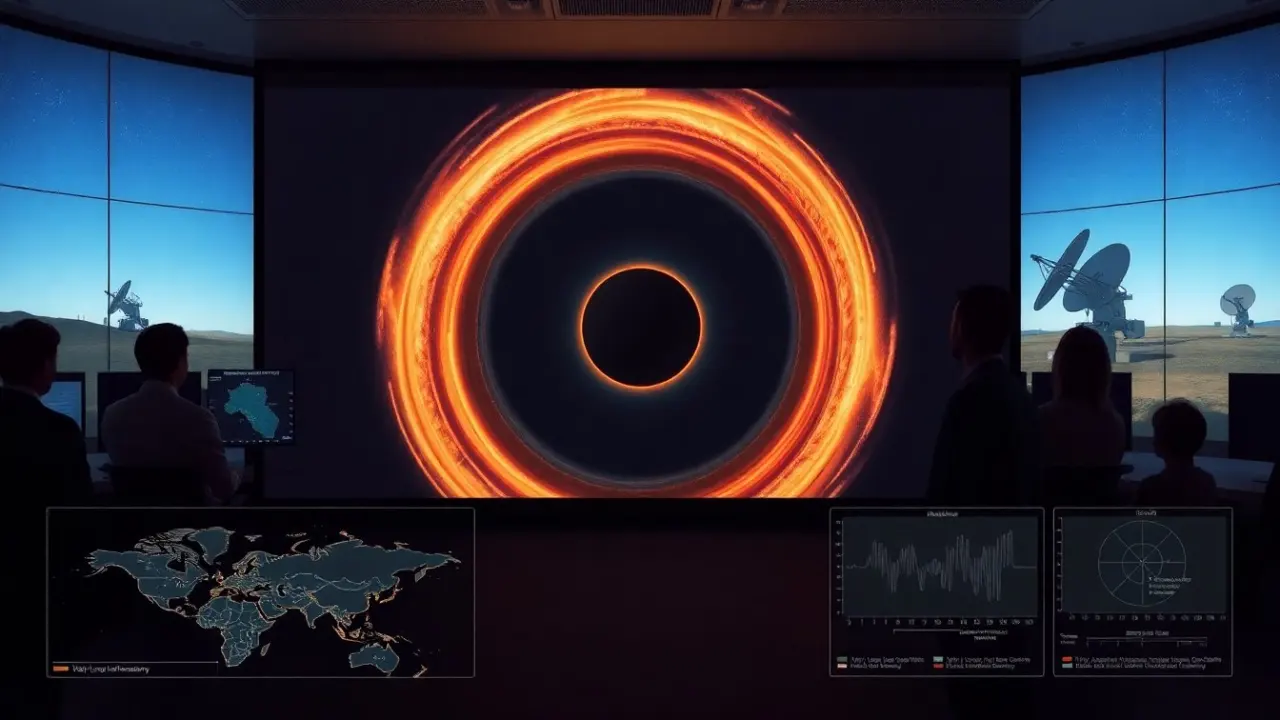
What do black holes look like is the question scientists ask when they get new data. Astronomers used radio telescopes and simulations to form first images. These images show a dark center and a bright ring. The ring comes from hot gas and light that bend near the hole. This article explains the visible features, how images form, and what future data will change.
Key Takeaways
- Black holes appear as a dark shadow surrounded by a bright ring formed by hot gas and bending light near their edge.
- The bright ring and fainter photon ring result from light orbiting the black hole and escaping, creating a distinctive visual signature.
- Accretion disks and magnetic jets contribute to the brightness and shape of the black hole’s appearance, varying with gas activity and angle of observation.
- Astronomers create black hole images using the Event Horizon Telescope and interferometry, combining radio data from multiple dishes to simulate a giant Earth-size telescope.
- Factors like black hole spin, viewing angle, and surrounding environment significantly alter how black holes look in images.
- Future observations with higher resolution and multiwavelength data will enhance our understanding of black hole features and refine the visuals we see.
Visible Signatures: The Shadow, Photon Ring, And What We Can See
The answer to what do black holes look like starts with the shadow. The shadow appears as a dark circle where light falls into the hole. Hot gas outside the hole emits light and creates a bright outline. Gravity bends light and concentrates it near the edge. Observers see a bright ring that defines the hole boundary. The photon ring forms from light that orbits the hole before escaping. That ring appears thinner and fainter than the main bright ring. Telescopes capture the bright ring more easily than the photon ring. Together, the shadow and rings give a clear visual signature.
The Shadow Versus The Photon Ring: Why A Black Hole Looks Like A Dark Circle Surrounded By Light
The shadow arises where light has no path out. The photon ring forms from light that loops near the hole and then escapes. Light that loops many times produces a narrow, high-contrast ring. Light from the accretion disk produces a wider, brighter ring. Observers often see a bright crescent when gas orbits unevenly. The contrast between the black center and the ring explains why images show a dark circle surrounded by light. Simulations confirm this pattern for many viewing angles.
Accretion Disks And Jets: Bright Structures That Define A Black Hole’s Appearance
Gas falls toward the hole and forms an accretion disk. The disk heats and emits light across radio, infrared, and X-ray bands. The inner disk gives most of the visible ring brightness. Magnetic fields can launch jets that appear as narrow beams. Jets can extend far beyond the disk and change the image when they point toward Earth. Disk brightness varies with time and alters how the ring appears. Observers link disk patterns to the hole’s feeding rate and magnetic activity.
Images Versus Reality: How Simulations Fill The Gaps Between Photos
Scientists ask what do black holes look like when they compare images to simulations. Images provide limited detail because telescopes have finite resolution. Simulations compute how light moves near a hole and predict the ring and shadow shapes. Researchers change spin, disk thickness, and viewing angle to match observations. Simulations also predict fainter features like the photon ring and lensing arcs. Teams use simulated images to test data-processing choices and to avoid false features. So simulations act as a bridge between raw data and physical interpretation.
How Astronomers Capture Black Hole Images: Telescopes, Interferometry, And Image Processing
Astronomers ask what do black holes look like and then plan observations. The Event Horizon Telescope links radio dishes worldwide in a technique called very long baseline interferometry. This method creates a virtual telescope the size of Earth. Observers record synchronized radio waves and combine them in software to build an image. Processing uses algorithms that fill gaps in data and reduce noise. Teams test multiple algorithms to ensure consistent features. Calibration and repeated observations reduce artifacts and increase confidence in the final image.
Factors That Change A Black Hole’s Appearance: Spin, Viewing Angle, And Environment
Several factors change what do black holes look like in images. Spin shifts the bright ring and alters the shadow shape. A fast spin makes the ring asymmetric and can shift the apparent center. Viewing angle changes disk brightness: edge-on views show different profiles than face-on views. The gas density and temperature around the hole change ring brightness and width. Magnetic fields change disk structure and jet power. Nearby stars or gas clouds can add extra light and confuse simple interpretations.
What We Still Don’t Know And How Future Observations Will Change What We See
Researchers still ask what do black holes look like at higher detail. Current images show the main ring and the shadow, but they do not resolve the faint photon ring well. Future arrays will add more dishes and increase resolution. Observers will use shorter radio wavelengths to see finer structure. Multiwavelength campaigns will link radio images to infrared and X-ray behavior. Improved algorithms will separate true features from processing artifacts. These advances will refine measurements of spin, mass, and the disk physics and will reveal smaller-scale features around the hole.