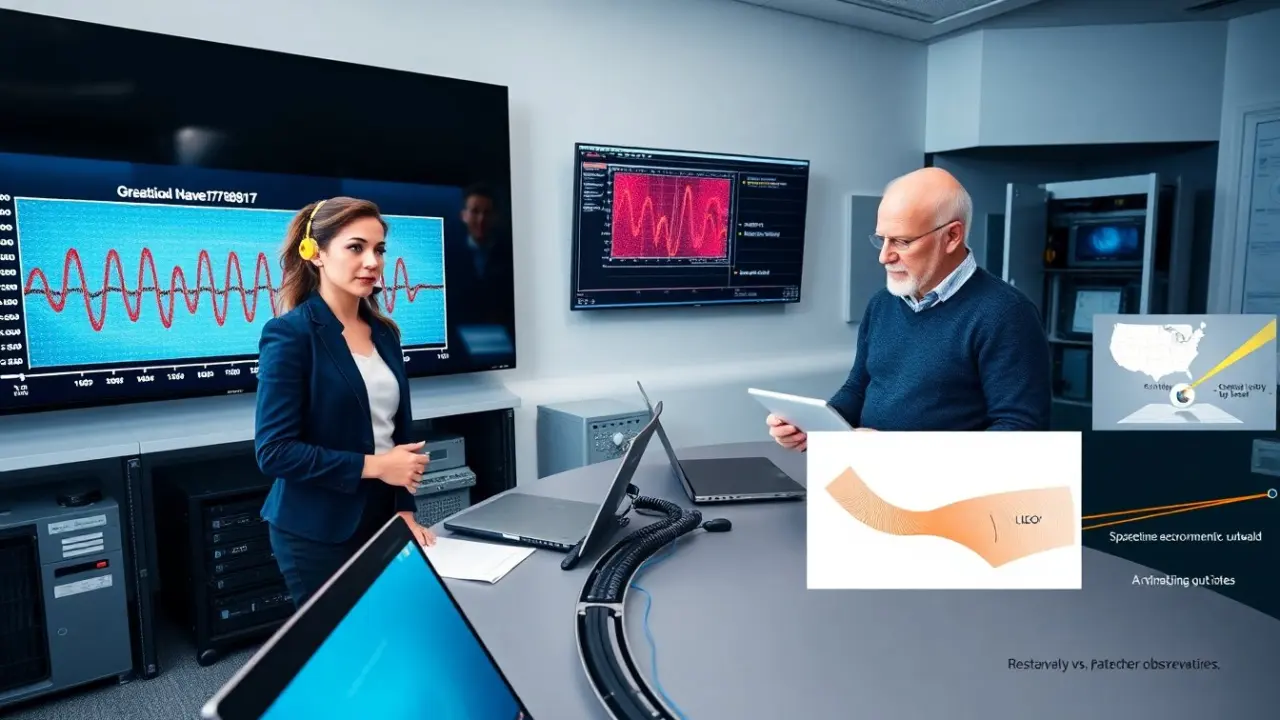
what is the speed of gravity is a common question in physics. Scientists test whether gravity acts instantly or travels at a finite speed. This article states current evidence and explains how measurements link gravity to light speed. It keeps language simple and facts clear.
Key Takeaways
- The speed of gravity refers to how fast gravitational effects, waves, and information travel between masses.
- General relativity predicts gravity propagates at the speed of light, replacing Newton’s idea of instantaneous gravity.
- Measurements from gravitational wave detectors like LIGO, Virgo, and KAGRA confirm gravity waves travel at light speed with extremely high precision.
- The 2017 neutron star merger event precisely matched gravitational wave and light signal speeds, confirming their equality within one part in 10^15.
- Binary pulsar timing observations support gravitational waves losing energy at light speed and constrain deviations from this speed.
- Gravity traveling at light speed preserves causality, supports cosmological models, and limits alternative gravity theories.
What “Speed Of Gravity” Actually Means: Force, Waves, And Information
The phrase “what is the speed of gravity” asks how fast gravitational effects travel. Physicists separate force, waves, and information. A body exerts a gravitational pull. That pull can change when the body moves. Gravity waves carry energy. Gravity information tells other masses about changes. The speed of gravity hence means the speed at which that information and waves move. Observers read effects and infer the propagation speed. Clarity helps avoid confusion between instantaneous action and propagating signals. Experiments test whether changes appear instantly or after a delay consistent with a finite speed.
Three related but distinct concepts are commonly mixed: the instantaneous value of a static gravitational field in a chosen coordinate system, the propagation speed of dynamic disturbances (gravitational waves), and the speed at which causal information about a change can travel. Modern treatments focus on causal propagation: if you rearrange mass in one place, how long before that rearrangement can influence another distant object? That is what experimental tests and theory aim to answer when addressing “what is the speed of gravity.”
Newtonian Gravity Versus General Relativity: Instant Action Or Finite Propagation?
Newton treated gravity as an instantaneous force. Astronomers used Newtonian gravity for centuries. Einstein replaced Newton with general relativity in 1915. General relativity describes gravity as spacetime curvature. Changes in mass-energy create ripples in spacetime. Those ripples travel at a finite speed in the theory. The theory predicts that the speed equals the speed of light. Physicists test that prediction with observations. The question “what is the speed of gravity” hence asks whether reality follows Newton or Einstein. Current theory and evidence favor Einstein’s finite propagation.
Conceptually, Newtonian gravity works extremely well for many practical problems because the effects of finite propagation are negligible at everyday speeds and distances. But when masses move relativistically or when strong-field, time-varying events occur (for example, compact-object mergers), the finite propagation predicted by general relativity becomes measurable. Thus determining “what is the speed of gravity” is both a test of theoretical foundations and a probe of regimes where Newton’s approximation breaks down.
How We Measure The Speed Of Gravity: Observations And Experimental Tests
Scientists measure gravity speed with direct and indirect methods. They watch gravitational waves and orbital changes. They time signals and compare arrival times. They use many detectors to triangulate source location. They use electromagnetic counterparts to compare light and gravity arrival times. They use pulsar timing to test delays in binary systems. Each test yields constraints on how fast gravity moves. The tests ask the question “what is the speed of gravity” in multiple ways. Combined results narrow the allowed range and support a finite, light-speed value.
Practically, measurements break down into timing comparisons, waveform propagation analyses, and long-term orbital monitoring. Timing comparisons require precise clocks and careful accounting for travel times through intervening space. Waveform analyses require accurate models of how waves are generated and how detectors respond. Orbital monitoring demands long data sets and detailed modeling of non-gravitational influences. Cross-checking different methods reduces systematic uncertainties and helps distinguish true propagation effects from source or detector artifacts.
Gravitational Waves: Direct Measurements From LIGO/Virgo/KAGRA
LIGO, Virgo, and KAGRA detect gravitational waves from mergers. These detectors measure waveforms and arrival times. Analysts extract the wave speed from how waves travel between detectors. They also compare inferred source positions with electromagnetic observations. The detectors show that gravitational waves travel at a speed consistent with light. The typical uncertainty sits within parts in 10^15 for many events. Those bounds answer the question “what is the speed of gravity” with strong precision. The result supports general relativity and limits alternative theories that predict different speeds.
In practice, determining the wave speed from detector data requires combining signals from multiple observatories, modeling the expected arrival-time differences for a light-speed signal, and ruling out alternative explanations such as dispersion or frequency-dependent propagation. Detector networks also allow sky localization and cross-correlation with telescopes; when an electromagnetic counterpart is found, the comparison becomes a near-direct test of propagation speed rather than an inference based solely on waveform shape.
The 2017 Binary Neutron Star Event And Multi-Messenger Constraints
The 2017 neutron star merger GW170817 produced light and gravity signals. Observers saw gamma rays 1.7 seconds after the gravitational wave signal. Analysts used travel distance to convert that delay into a speed limit. They concluded that gravity and light travel at the same speed to within one part in 10^15. That event answered “what is the speed of gravity” in practical terms. The small delay left room for source physics, but it left little room for large speed differences. Multi-messenger timing so provided a clear, near-direct measurement.
Interpreting that small delay requires care: some portion can arise from how and when electromagnetic emission is produced after the merger, not from propagation. Researchers therefore combine waveform modeling, astrophysical understanding of the merger aftermath, and the measured arrival times to isolate propagation effects. Even accounting for plausible source delays, the conclusion remains that any difference between the speeds of gravity and light must be extremely small, strongly constraining theoretical alternatives.
Indirect Evidence: Binary Pulsars, Orbital Decay, And Timing Tests
Binary pulsars yield long-term tests of gravity. Observers track pulse arrival times over decades. Systems like the Hulse-Taylor pulsar show orbital decay that matches predicted energy loss from gravitational waves. Analysts infer that waves carry energy at a speed that matches general relativity. Timing tests constrain deviations from light speed. They also test whether gravitational influence propagates differently than waves. Those constraints answer parts of “what is the speed of gravity” by supporting wave propagation at light speed and limiting alternative models.
These indirect methods are powerful because they integrate many orbital cycles, amplifying tiny cumulative effects. By comparing timing data to relativistic models that include gravitational-wave emission, Doppler shifts, and relativistic time delays, researchers can place tight bounds on both the amplitude and propagation properties of gravitational radiation. While these results are not a single-shot speed measurement like a multimessenger timing comparison, they provide independent and complementary evidence for light-speed propagation of gravitational effects.
Why The Speed Equals The Speed Of Light Matters: Causality, Propagation, And Cosmology
The equality of gravity speed and light speed preserves causality in physics. If gravity moved faster than light, signals could arrive before causes. That scenario would break standard cause-effect relations. Equal speeds simplify models of structure growth and cosmology. They let cosmologists use the same light-speed limit for gravitational signals in simulations. They also restrict modified-gravity theories that predict different speeds. The empirical answer to “what is the speed of gravity” hence has wide impact on theory and observation in modern physics.
Beyond foundational concerns, the propagation speed affects practical modelling: predictions for gravitational lensing, black-hole mergers, cosmic structure formation, and early-universe dynamics all rely on consistent causal behavior. A confirmed equality with light speed keeps the standard relativistic framework intact and narrows the landscape of viable alternative theories. For researchers, answering “what is the speed of gravity” is therefore not only a measurement challenge but a way to sharpen our picture of how the universe evolves and how signals of different kinds interact across cosmic distances.