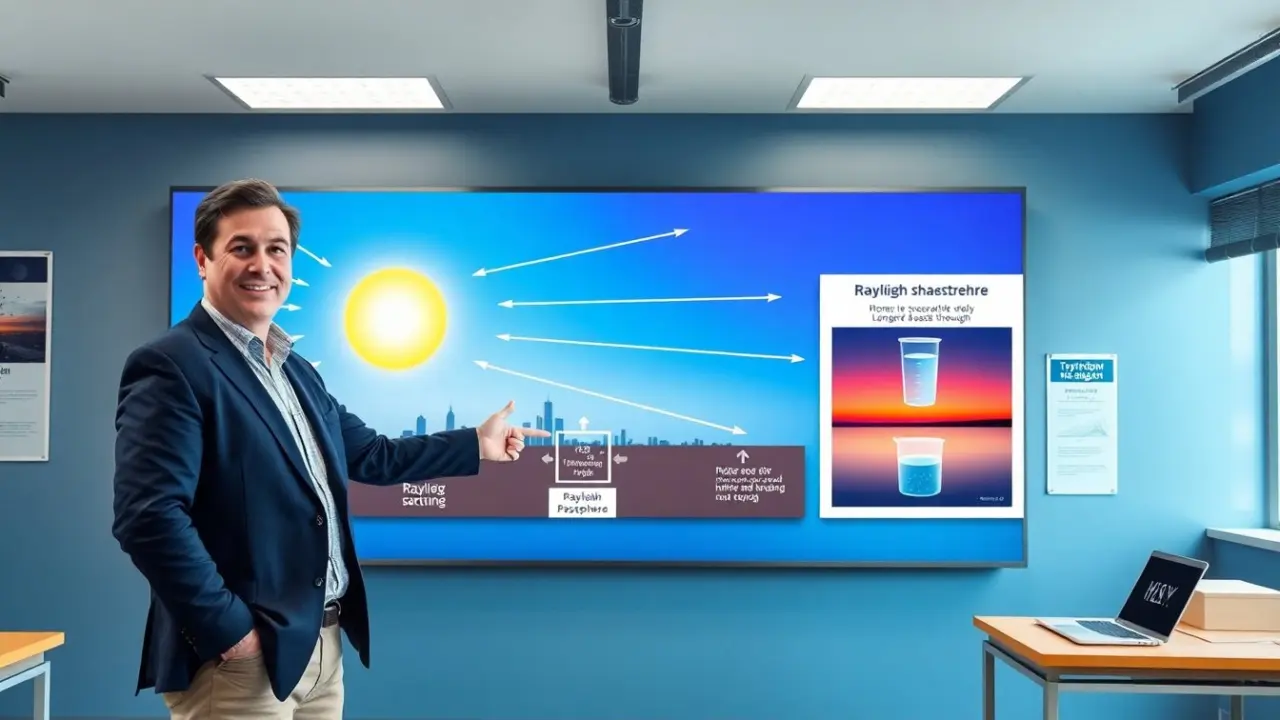
Why is the sky blue? Scientists explain this by how sunlight meets air. Sunlight contains many colors. Air molecules change sunlight direction. Blue light changes direction more than red light. The result makes people see blue across the day sky. This article explains the core steps that make the sky blue and what changes that color at sunrise and sunset.
Key Takeaways
- The sky appears blue because air molecules scatter shorter wavelengths of sunlight, like blue, more than longer wavelengths such as red.
- Rayleigh scattering explains why blue light is scattered many times more strongly, making the daytime sky predominantly blue.
- Sunsets appear red because sunlight travels through more atmosphere, scattering away blue light and leaving mainly red and orange hues.
- Variations in sky color depend on factors such as Sun angle, atmospheric clarity, humidity, and particle concentration.
- Common misconceptions, like the ocean causing the sky’s blue color, are false; the sky’s blue results from light scattering, not reflections.
How Scattering Of Sunlight Works
Sunlight travels from the Sun to Earth as mixed colors. Air on Earth contains molecules and small particles. Photons of light hit those molecules. The light changes direction when photons hit molecules. Scientists call this process scattering. Scattering sends some light away from the direct beam. Scattered light reaches the eye from many directions. The eye then sees the sky as a color made of scattered light. When people ask why is the sky blue, scattering is the core physical reason. Rayleigh described how small particles scatter shorter wavelengths more strongly than longer ones. This explanation fits clear daytime skies with low particle size.
Why Blue Light Is Scattered More Than Other Colors
Blue light has a shorter wavelength than red light. Air molecules scatter short wavelengths more strongly. The scattering strength follows an inverse fourth-power law with wavelength. This law makes blue light scatter many times more than red. Scattered blue light fills the sky from all directions. The eye and brain register that scattered light as blue. When people wonder why is the sky blue on a clear day, the short-wavelength scattering explains it. Some violet light scatters even more than blue, but the eye is less sensitive to violet. The mix of scattered blue and some violet results in the sky appearing blue to most observers.
Why Sunsets Turn Red
Sunsets turn red because sunlight travels a longer path through the atmosphere at low Sun angles. That longer path removes more short-wavelength light by scattering. The remaining light contains mostly longer wavelengths like red and orange. Observers then see red and orange colors near the horizon. The process answers why is the sky blue during the day and why it shifts to red at sunset. The change results from the same scattering physics acting over different path lengths and angles.
Variations In Sky Color: Pale, Deep Blue, And Greenish Hues
Sky color varies with Sun angle, atmospheric clarity, and humidity. Midday skies appear deep blue when the air is clean and dry. The sky looks paler when particles or haze increase. High humidity and thin clouds scatter light and wash out blue. Greenish hues can appear before severe weather because of selective scattering and cloud color mixing. Polar regions and high altitudes show a deeper blue because the column of air contains fewer scatterers. When observers ask why is the sky blue but sometimes pale or deep, they should check the air clarity and Sun angle for a simple explanation.
Common Misconceptions And Everyday Implications
A common misconception says the sky is blue because the ocean reflects its color. The ocean does not cause the sky to be blue. The sky looks blue independently of the ocean for the same scattering reasons. Another misconception says human eyes make the sky blue by filtering light. Eyes do affect color perception, but they do not create the blue color without scattered light. Everyday implications include aviation and photography. Pilots use sky color to judge visibility and particle load. Photographers choose times with deep blue skies for strong color contrast. Teachers can use simple demonstrations with clear water and a small amount of milk to show scattering and to answer why is the sky blue in class.